Imagine a car with all its components carefully laid out: the engine, wheels, gearbox, steering system, and electronics. Each component is of high quality and has a clear function. Yet this collection of individual parts will not take you anywhere. Only when they are assembled according to a blueprint does a car emerge that is actually capable of driving.
The same principle applies to processes within organizations. Processes such as purchasing, contract management, and supplier relationship management are often well described and logically designed, but without coherence they remain isolated components. Real value, the contribution to the organizational goals, only truly materializes when processes work together effectively. This starts with insight into the interrelationships and interfaces between these processes. That is exactly what the CATS sourcing framework provides.
Introduction
Relationships with suppliers play an increasingly significant role in operations. Where the focus once was primarily on procuring products or simple services, it has shifted toward long‑term and complex collaborative relationships, formalized through contracts. The financial and organizational impact of these relationships is growing, making ad hoc action insufficient.
Many organizations describe their processes in isolation, just as many models and best practices do. The CATS best practices also each focus on a specific domain, such as contract management or supplier relationship management. This focus is logical, but it carries the risk of siloed thinking.
The CATS Sourcing Framework
The CATS sourcing framework presented below makes the processes surrounding suppliers and contracts transparent.
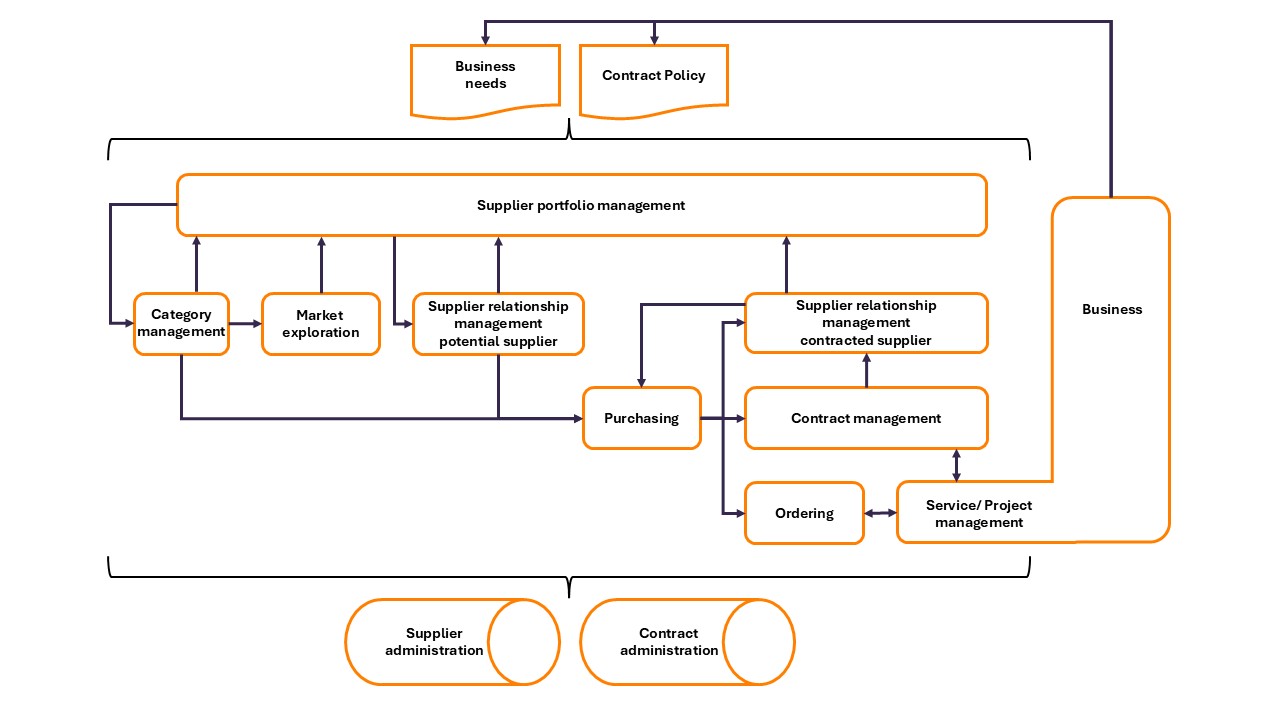
The CATS sourcing framework
The framework provides insight into the processes that arise or are affected, as well as their interactions. It helps organizations better understand roles, responsibilities, and dependencies, and to organize them deliberately.
The Interconnected Components
Operations form the starting point and are aimed at realizing the organizational goals. Suppliers and contracts are used where necessary to deliver the required products and services. Through supplier portfolio management, category management, and purchasing, the organization makes choices about outsourcing and supplier selection, with the objective of achieving optimal contributions to the organizational goals.
After contracts are concluded, a new phase begins: actively managing agreements and performance. Contract management plays a central role here, in close alignment with service management, project management, and day‑to‑day operations. Only when contractual agreements align with operational execution is the intended value actually realized.
Supplier relationship management connects these processes and is present both during contract creation and during contract execution.
The Value of Coherence
The strength of the CATS sourcing framework lies in providing an overview of this coherence. It supports an integrated approach to processes surrounding contracts and suppliers and functions as a practical and conceptual compass for organizations. As such, the framework forms the connective foundation underlying CATS CM®, CATS RVM®, and CATS SRM®, and helps organizations apply these best practices effectively and in an integrated manner.
 Contact
 Buy Book